Types of LED Lights for Your Space
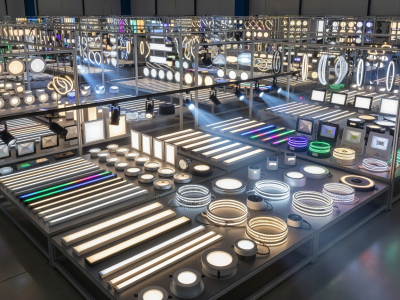
The versatility of Light Emitting Diodes (LEDs) goes far beyond simple energy savings. Because LEDs are highly compact solid-state components, manufacturers can embed them into form factors that were physically impossible with older incandescent or fluorescent technologies. Selecting the right type of LED for a specific application requires understanding the physical structures, light distribution patterns, and thermal limitations of each format.
1. Standard Retrofit Bulbs
For most residential applications, the entry point into solid-state lighting is the retrofit bulb. These are designed with standard bases (such as E26 or E27 screw bases) to act as drop-in replacements for traditional fixtures.
- A-Series (A19/A21): The classic teardrop shape. Ideal for lamps, ceiling fans, and general room illumination. They emit light in an omnidirectional pattern, though the base mechanism often restricts light immediately below the socket.
- BR-Series (BR30/BR40): Bulged Reflector bulbs. These are specifically shaped to direct light straight ahead and slightly out to the sides. They are heavily utilized in recessed ceiling cans or track lighting where wide, ambient light is needed.
- PAR-Series (PAR20/PAR30/PAR38): Parabolic Aluminized Reflector bulbs. These offer a tighter, more focused beam than BR bulbs. They are commonly used for exterior security lighting, art highlighting, or high-ceiling recessed applications.
2. LED Strip and Tape Lighting
Flexible LED strips consist of a flexible circuit board populated with Surface Mounted Device (SMD) LEDs. These strips are often backed with an adhesive, allowing them to be mounted in hidden coves, under cabinets, or behind monitors for bias lighting.
The nomenclature for these chips usually corresponds to their physical dimensions in tenths of a millimeter. For instance:
| Chip Type | Dimensions | Common Application | Brightness Profile |
|---|---|---|---|
| SMD 3528 | 3.5mm x 2.8mm | Accent lighting, stairs | Low to Medium |
| SMD 5050 | 5.0mm x 5.0mm | Primary room lighting, RGB color mixing | High |
| SMD 2835 | 2.8mm x 3.5mm | High-efficiency continuous runs | Very High |
3. LED Downlights and Wafers
Instead of placing a bulb inside an existing metal can housing, modern construction frequently utilizes integrated LED downlights. These fixtures are entirely self-contained, housing the driver, heat sink, and diode array within a single unit.
A recent innovation in this category is the "wafer" light. These are ultra-thin (often less than an inch thick) downlights that do not require traditional deep housings. Because they are so thin, they can be mounted directly into drywall ceilings directly beneath joists or plumbing, resolving layout conflicts that once plagued architects and electricians. They typically connect to a remote junction box that sits safely away from the fixture.
4. Flat Panels and Troffers
In commercial and office environments, the traditional fluorescent tube (T8/T12) housed in a 2x4 or 2x2 grid ceiling is rapidly being replaced by LED flat panels. These panels distribute light evenly across a wide surface area using an edge-lit or direct-lit design paired with highly engineered acrylic diffusers.
Pros: Excellent shadow reduction, clean aesthetic, and zero flickering.
Cons: Generally restricted to drop-ceiling installations, and entire units must be replaced if the internal driver fails.
5. Filament LEDs
Aesthetically driven, filament LEDs mimic the classic look of Edison-style incandescent bulbs. Inside the glass envelope, tiny LED chips are arranged linearly on transparent substrates (usually glass or sapphire), coated with a phosphor layer that gives them a yellow appearance when off. These are purely decorative and are favored in exposed-bulb fixtures like industrial chandeliers or wall sconces.
Selecting the Right Form Factor
When selecting a type, always consider the beam angle. An A19 bulb throws light 360 degrees, making it great for a lamp shade, but inefficient for a ceiling can where half the light gets trapped inside the housing. Conversely, using a narrow PAR bulb in a table lamp will result in a harsh, localized spotlight. Match the form factor to the physical constraints and intended light spread of your environment.